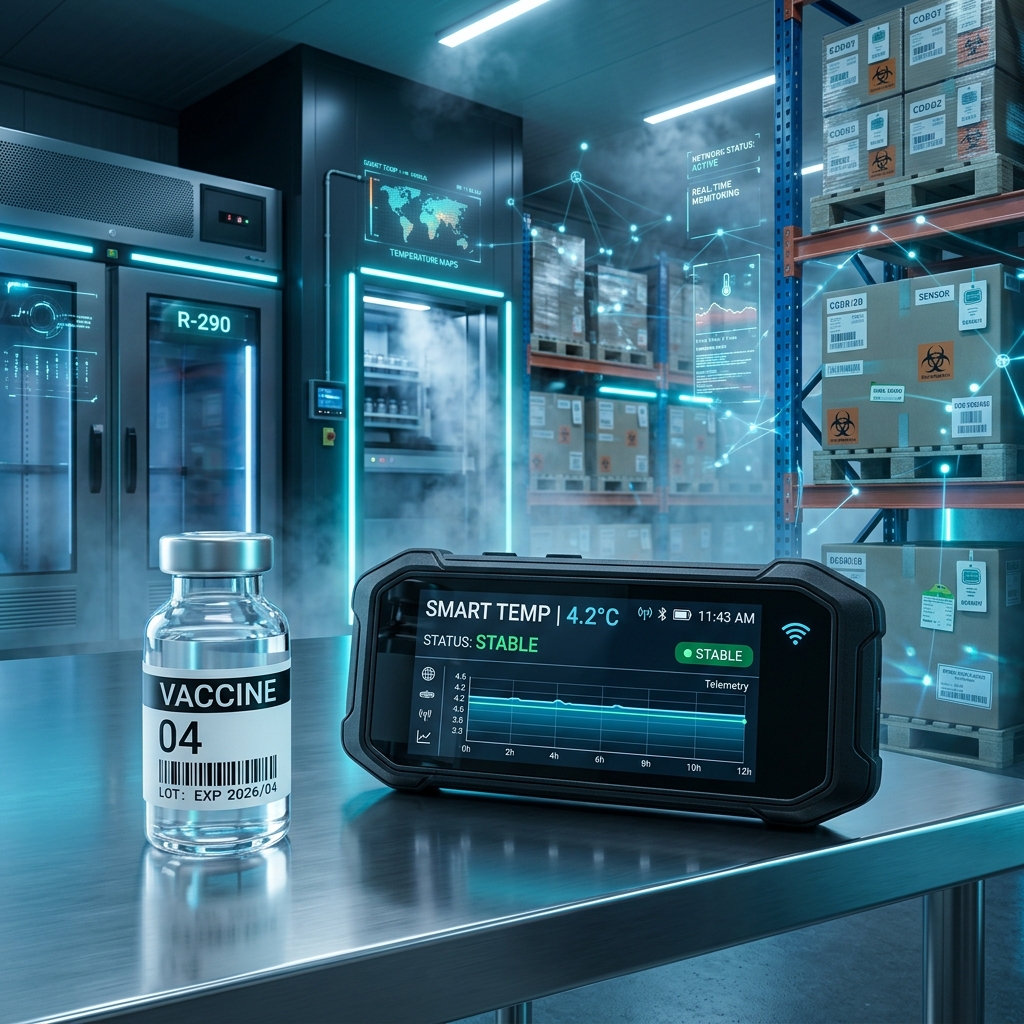
In global healthcare logistics, few challenges are as demanding as the cold chain. Biological drugs, active vaccines, and clinical trial samples must be maintained within precise temperature bounds from formulation to syringe. A single degree fluctuation can render millions of dollars of life-saving inventory entirely inert.
Historically, logistics teams relied on manual logs or USB-based temperature strips that could only be analyzed after the transport had concluded. If a refrigeration failure occurred, it was discovered far too late. Today, smart automated IoT logging is changing the landscape, transforming reactive losses into proactive corrections.
The Regulatory Baseline: FDA 21 CFR Part 11
Under strict global frameworks, particularly the US FDA's 21 CFR Part 11 and EU Annex 11, pharmaceutical distributors must verify a continuous, tamper-proof audit trail for environmental conditions during transport and storage.
Non-Compliance Penalties
FDA Warning Letters due to continuous temperature monitoring violations can shut down production lines for weeks, costing firms upwards of $150,000 per day in lost capacity.
Satisfying these audits requires automated systems that generate indelible electronic signatures, protect records from modification, and alert operators instantly to deviations. This is where modern telemetry platforms provide an absolute operational and legal safeguard.
Critical Points in the Logistics Journey
Data logging is vital across three critical segments in the pharma distribution chain:
- Active Warehousing: Storing raw reagents in specialized sub-zero vaults requiring 24/7 logging with redundant backups.
- Transit Containers: Active and passive cold boxes loaded onto cargo flights, which rely on secure offline flash storage during long intervals in transit.
- Last-Mile Delivery: Final distribution to hospitals and clinics where rapid courier handoffs introduce the highest risk of thermal shock.
Technical Validation & Sensor Accuracy
To qualify for biotech use, logging hardware must be subjected to thorough validation protocols. RTD (Resistance Temperature Detector) and NTC thermistor sensors must provide a continuous tracking accuracy within ±0.2°C across active ranges.
| Logger Parameter | Standard USB Strip | AIoTHUB Multi-Channel IoT |
|---|---|---|
| Alert System | Post-delivery inspection | Real-time SMS / Email / WhatsApp |
| Accuracy Bounds | ±0.5°C to ±1.0°C | ±0.1°C to ±0.2°C (Calibrated) |
| Storage Capacity | 32,000 logs | Over 1,000,000 logs (Flash Backup) |
| Compliance Alignment | Basic logging | Fully FDA 21 CFR Part 11 Compliant |
"Transitioning from retroactive analysis to real-time, sensor-driven action is the single most critical investment a pharma operations director can make this decade."
Strategic Takeaways for Managers
- Audit Readiness: Moving to dynamic cloud-hosted logs eliminates human entry errors entirely.
- Instant Alert Thresholds: Configure progressive SMS cascades if temperatures wander for more than 15 consecutive minutes.
- Zero-Power Fail-Safes: Ensure loggers have internal lithium cells capable of continuing records even when vehicle battery links disconnect.
Sensing the Path Forward
The convergence of longer-lasting battery arrays, ultra-reliable solid-state sensors, and seamless cellular handoffs means pharmaceutical compliance is no longer a game of chance. Embracing automated IoT data loggers is the ultimate move to safeguard both corporate reputation and public health.