Key Takeaways:
- “Wireless” doesn’t mean wire-free. A wireless data logger still uses a wired sensor or probe. The word “wireless” only describes how the logger sends data to the dashboard, not how the sensor connects to the logger.
- A data logger is not the only expense of your project. The cost includes cabling, network equipment, maintenance, data plans, and future expansion. A low price tag on the logger doesn’t guarantee a low total cost.
- Always ask what happens when the connection drops. A good logger should keep recording locally during a network or power outage and send the missing data to the dashboard once the connection returns. This is easy to overlook but critical.
- Instead of running long cables from every sensor back to one location, putting loggers closer to sensor groups cuts cabling costs. This makes a hybrid setup the most practical choice for most factories.
Choosing between wired and wireless data loggers depends mainly on your plant layout, sensor locations, existing network infrastructure, and installation cost.
Wired data loggers are often a good choice when sensors are close to existing cable routes and monitoring points stay in fixed positions. Wireless data loggers are useful when equipment is spread across a large area, cables are difficult to install, or remote access is required.
For many industrial plants, a combination of both is the most practical solution.
But there is one important detail to understand before making a purchase. A wireless data logger still uses a wired temperature or humidity sensor. The term wireless describes how the logger sends data to a dashboard, not how the sensor connects to the logger.
Understanding this difference will help you choose a monitoring system that fits your factory without spending unnecessarily on cabling, network equipment, or additional devices.
Wired vs Wireless Data Loggers: Quick Comparison
| Feature | Wired Data Logger | Wireless Data Logger |
|---|---|---|
| Installation | Requires suitable cable routes | Often needs less communication cabling |
| Initial installation cost | Higher when cable routes are difficult | Lower where cabling is expensive |
| Reliability | Stable when correctly installed and maintained | Depends on signal coverage, interference, and network quality |
| Mobility | Moving equipment requires cable changes | Easier to monitor equipment in changing locations |
| Maintenance | Cables, connectors, and network equipment need inspection | Batteries, antennas, signal quality, and network equipment need attention |
| Remote monitoring | Possible through a connected network or gateway | Possible through Wi-Fi, cellular, or another supported network |
| Best suited for | Fixed installations and established cable infrastructure | Distributed, hard-to-reach, or frequently changing monitoring points |
Note: Neither option is automatically better. The right choice depends on how your facility is arranged and what you need to monitor.
What Is the Difference Between Wired and Wireless Data Loggers?
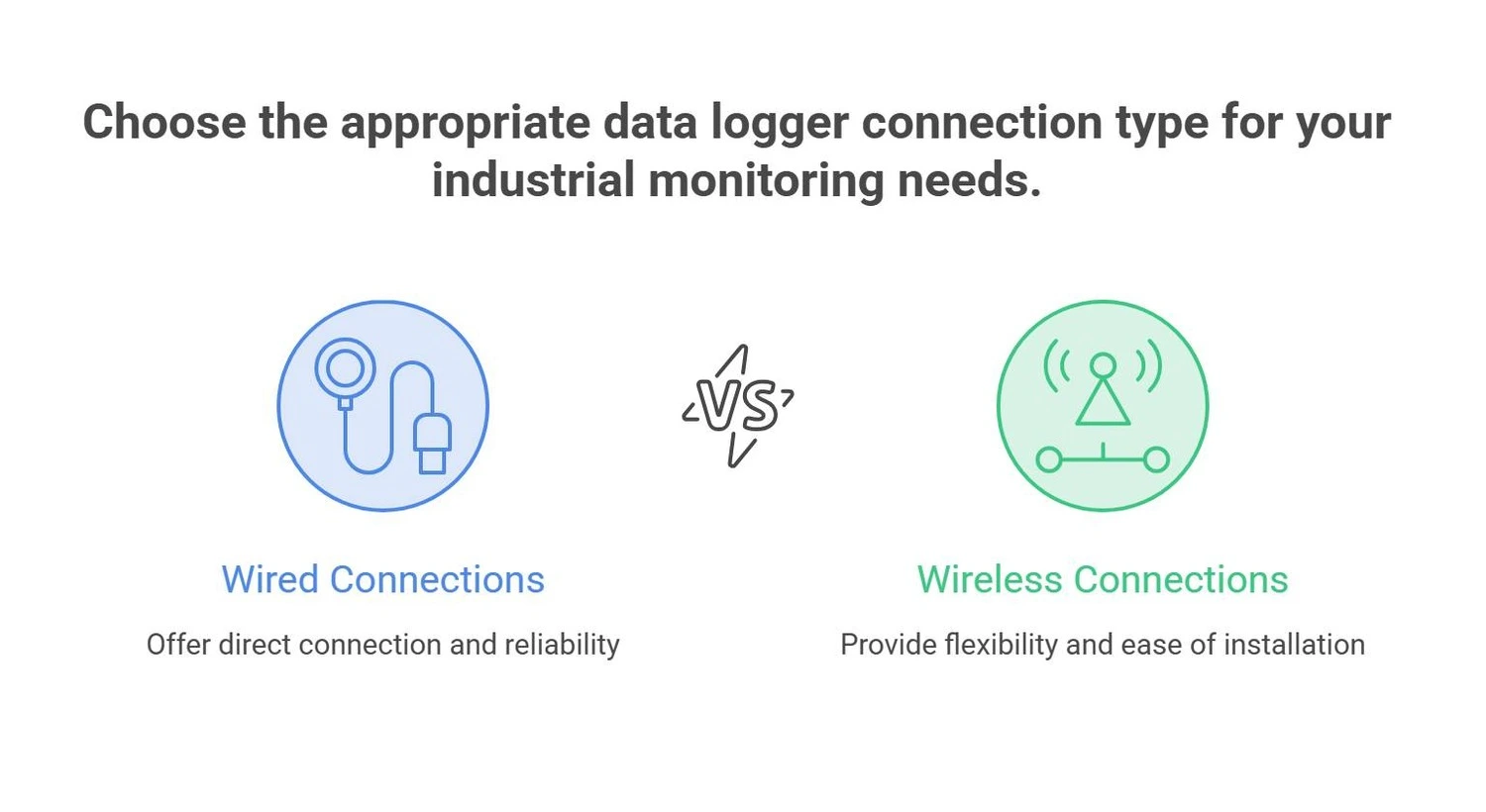
To select the right industrial data logger, it helps to separate the two different connections.
1. Sensor-to-logger connection
This is the connection between the sensor and the device that records its readings.
For example, a temperature sensor inside a cold room might connect to a nearby data logger using a wired probe. The logger measures the temperature and records the readings.
Wired sensor connections are common in industrial monitoring because they offer a direct connection and work well in permanent installations. However, the correct cable type, length, shielding, and installation method matter, especially around electrically noisy equipment.
Wireless sensors also send measurements to a logger or gateway without a direct signal cable. Their suitability depends on the sensor technology, power requirements, communication range, and site conditions.
2. Logger-to-network connection
This connection determines how recorded data reaches a computer, industrial control system, or cloud dashboard.
A data logger transfers information through Ethernet, Wi-Fi, 4G/LTE, or an industrial communication interface such as RS-485 using Modbus. For example, a temperature logger uses a wired probe inside a pharmaceutical refrigerator while transmitting recorded measurements to a cloud dashboard over Wi-Fi or Ethernet.
This is why choosing between wired and wireless data loggers is not always an either-or decision. You need to evaluate both connections separately.
When Should You Choose a Wired Data Logger?
A wired data logger is the right choice when your factory already has suitable cable trays, electrical conduits, control panels, or network infrastructure.
It is especially useful when the monitored equipment stays in one place and the distance between sensors and the logger is manageable.
1. Your sensors are close to the control panel
Suppose a production line has temperature and pressure sensors installed near a common control panel. Connecting them through properly installed cables is more practical than setting up separate wireless communication links.
Existing infrastructure can also reduce installation work because you may not need to build a new communication network.
2. You need a stable connection for fixed equipment
Some industrial applications require regular data collection from permanently installed sensors. Wired communication provides a predictable connection when cable routes and electrical conditions are properly managed.
However, wired systems are not immune to problems. Loose connectors, damaged cables, poor grounding, and electrical interference still affect readings or communication.
3. Your plant already uses PLCs or SCADA
Factories with programmable logic controllers (PLCs) and supervisory control and data acquisition (SCADA) systems may already have a wired communication network.
A compatible data logger integrates with this infrastructure using supported interfaces and protocols. Before purchasing, confirm protocol compatibility, communication distance, electrical isolation, and the requirements of your existing control system.
4. You want to avoid dependence on a local wireless signal
If monitoring points are surrounded by metal structures, machinery, or enclosed equipment that weakens radio signals, a wired connection is easier to manage.
The important point is to inspect the actual site rather than assume that every wireless connection will be unreliable.
Choose wired connectivity when: your monitoring points are permanent, cable routes are accessible, and existing infrastructure makes a wired installation practical.
When Is a Wireless Data Logger a Better Choice?
Wireless data loggers make installation easier when monitoring points are spread throughout a facility or when running additional cables would require significant civil or electrical work.
The benefits are particularly noticeable in existing factories where production must continue during installation.
1. Your factory has a large or spread-out layout
Consider a plant with separate production rooms, storage areas, utility sections, and a warehouse. Running cables from every monitoring point to one central location involves long cable routes, additional conduits, and more installation labour.
A wireless network reduces the need for communication cables between devices and the monitoring system. It still requires appropriate power arrangements, compatible sensors, and good network coverage.
2. You need to monitor remote locations
Some monitoring points are difficult to access regularly, such as remote utility equipment, water systems, outdoor installations, or isolated storage locations.
Depending on the available connectivity, a wireless data logger transmits measurements through Wi-Fi or a cellular network such as 4G/LTE. This allows teams to review readings remotely and receive alerts without visiting every location to collect data.
3. Your existing plant cannot easily accommodate new cables
Retrofitting a monitoring system into an operating factory is difficult. Cable installation requires drilling, conduit work, machine shutdowns, or changes to existing panels.
Wireless communication reduces some of this work, although a site survey is still important to confirm signal coverage and identify interference.
4. You expect monitoring requirements to change
If your factory regularly adds equipment or changes production layouts, wireless communication makes some future installations easier.
For example, a manufacturer may initially monitor two storage rooms and later add more environmental monitoring points. A properly designed wireless system supports this expansion when network capacity and device compatibility allow it.
Choose wireless connectivity when: your monitoring points are distributed, cable installation is expensive or difficult, and the site provides dependable communication coverage.
Which Type of Data Logger Fits Different Plant Layouts?
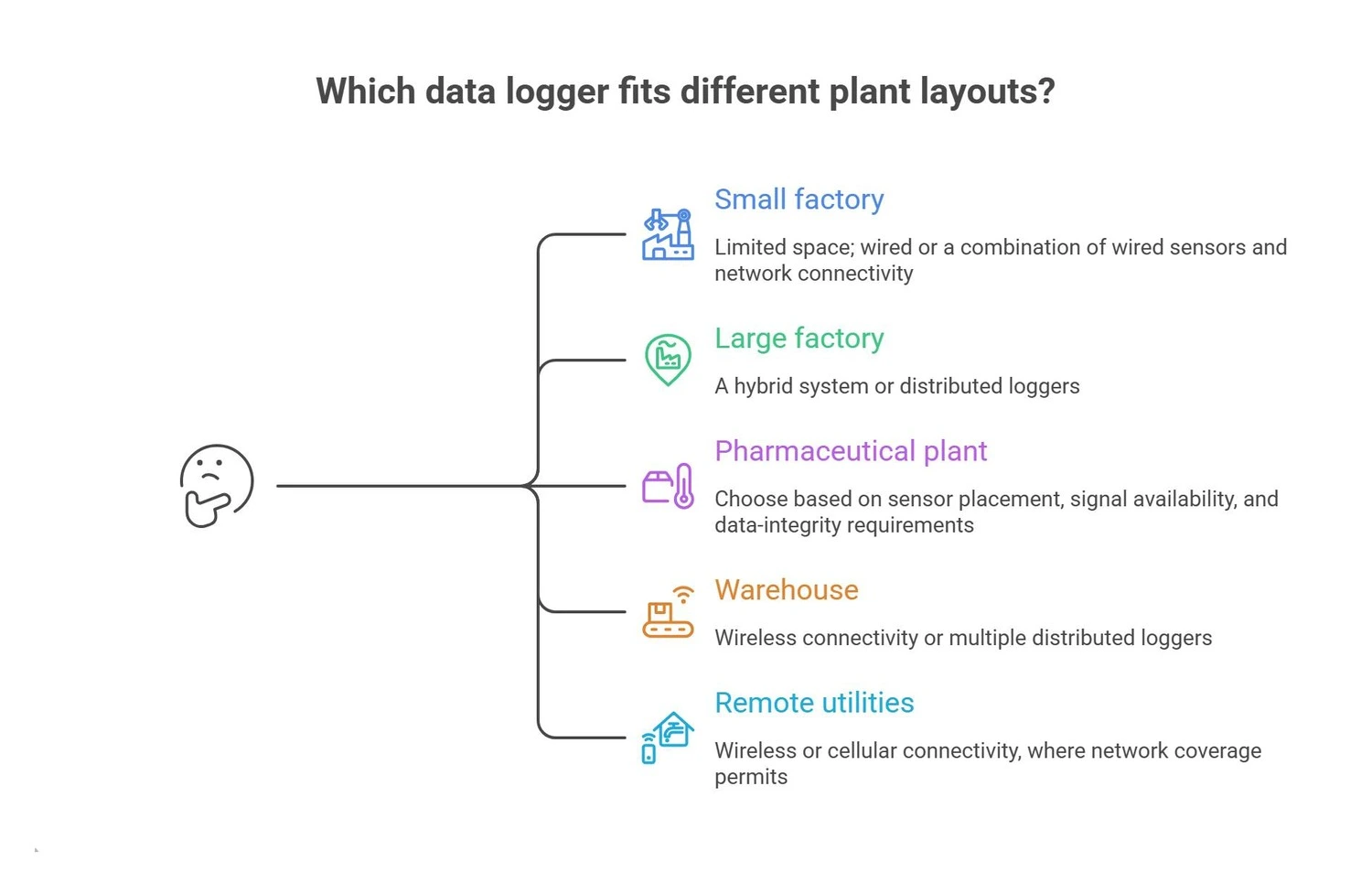
The physical arrangement of your monitoring points should guide your decision.
1. Small factory with limited space
Recommendation: Wired or a combination of wired sensors and network connectivity.
If most sensors are installed on the same machine or close to a control panel, wired connections are practical.
A multi-channel logger collects several measurements in one location, reducing the number of separate devices. Choose based on sensor compatibility, cable distances, measurement requirements, and the number of channels needed.
2. Large factory with separate production areas
Recommendation: A hybrid system or distributed loggers.
A large plant has monitoring points across production areas, utilities, storage rooms, and warehouses. So, instead of routing every sensor cable back to one central logger, consider placing loggers closer to groups of sensors. The devices then send data to a central dashboard through the plant's available communication network.
This approach reduces the need for long cables while giving the maintenance team a central view of the plant.
3. Pharmaceutical plant and cold-chain storage
Recommendation: Choose based on sensor placement, signal availability, and data-integrity requirements.
Pharmaceutical facilities need to monitor cold rooms, refrigerators, freezers, stability chambers, and warehouse conditions. For example, a wired temperature probe can be installed at a specific point inside a refrigerator while its connected logger remains outside the storage area. The logger then transmits records to a dashboard using a suitable network connection.
The final design must consider temperature measurement accuracy, calibration, alarm response, network interruptions, record retention, and applicable quality requirements.
Wireless connectivity is useful for remote access, but it does not remove the need for a properly designed and qualified monitoring system.
4. Warehouse with distant monitoring points
Recommendation: Wireless connectivity or multiple distributed loggers.
A warehouse has temperature and humidity monitoring points across separate aisles, storage zones, and loading areas. Running communication cables to every point can be expensive, particularly when cable routes must avoid existing racks and operations.
A wireless system is practical if it provides sufficient coverage. Test connectivity in the actual installation locations and pay attention to metal racks, enclosed rooms, and areas with changing stock levels.
5. Remote utilities and isolated equipment
Recommendation: Wireless or cellular connectivity, where network coverage permits.
Water systems, pumps, electrical installations, and other remote assets may be difficult to monitor through a central wired network.
Here, a data logger with suitable cellular connectivity is helpful, as it transmits information from locations without reliable local Wi-Fi. But first, confirm mobile network availability, power supply, antenna placement, data-plan costs, and local storage before selecting the device.
Hidden Costs to Consider Before Buying
A low device price does not always mean a low installation cost. Consider the full project before choosing a data logger.
| Cost factor | Wired installation | Wireless installation |
|---|---|---|
| Cabling | Cable, conduit, connectors, and labour | Need less communication cabling |
| Network equipment | Switches, ports, or gateways as required | Access points, antennas, or gateways as required |
| Installation downtime | Increase when cable routes need modification | Reduce some installation work |
| Ongoing maintenance | Cable and connector inspection | Signal checks, batteries where applicable, and network maintenance |
| Communication costs | Depends on the network arrangement | Cellular plans or other service costs apply |
| Future expansion | New cable routes require | Additional devices require compatible network capacity |
These are possible costs, not fixed rules. A plant with existing Ethernet infrastructure may find a wired system more economical than a wireless alternative. In another facility, wireless communication saves substantial installation work.
Can You Combine Wired and Wireless Data Loggers?
Yes. For many manufacturing facilities, a hybrid monitoring system is a sensible option. A hybrid setup uses wired connections where they are easy to install and wireless communication where it provides a clear advantage.
For example, a factory could use wired sensors around a production machine, Ethernet to connect a logger near the control panel, and cellular connectivity for a remote utility building.
This arrangement helps engineers to choose the most suitable connection at each monitoring point. A practical hybrid design follows three principles:
- Keep sensor cables short and properly installed where possible.
- Place loggers near groups of sensors when doing so reduces complex cable routes.
- Use the appropriate plant network or wireless connection to transfer records to a central dashboard.
How to Choose the Right Data Logger for Your Plant
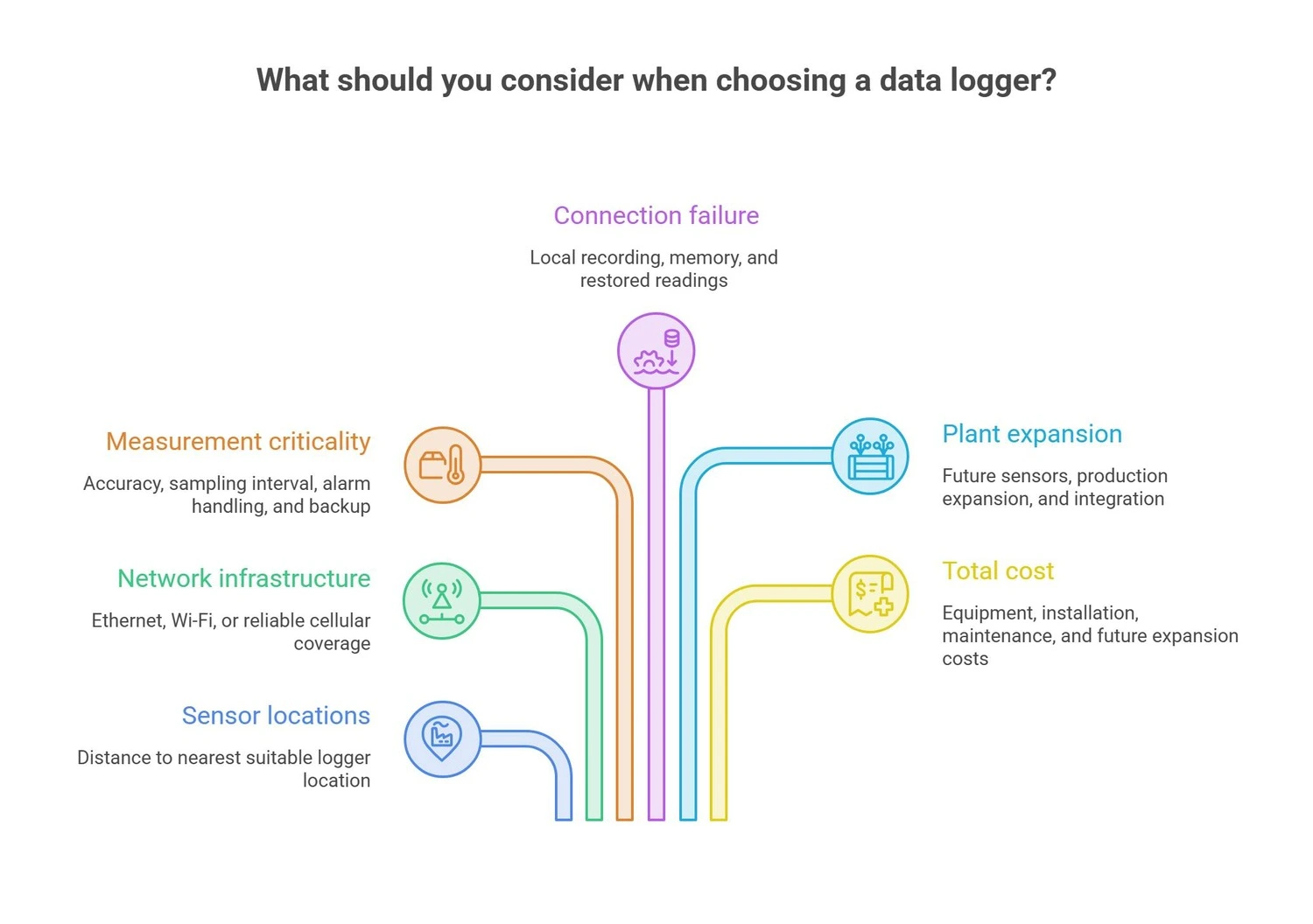
Before selecting a model, answer these questions honestly.
1. Where are your sensors located?
Map each monitoring point and estimate the distance to the nearest suitable logger location. Note walls, machinery, metal enclosures, and existing cable routes.
2. Is suitable network infrastructure already available?
Check whether the plant has Ethernet, Wi-Fi, or reliable cellular coverage in the required locations.
3. How critical is the measurement?
Temperature excursions in pharmaceutical storage have different consequences from monitoring ambient conditions in a general workshop. Match the measurement accuracy, sampling interval, alarm handling, and backup arrangements to the application.
4. What happens when the connection fails?
Ask whether the logger continues recording locally, how much memory it has, and how readings are restored to the dashboard when communication returns.
5. Will the plant expand?
Consider future sensors, production expansion, extra monitoring points, and integration with PLC or SCADA systems. Planning can prevent expensive changes later.
6. What is the total cost over time?
Compare equipment, installation, maintenance, network services, calibration, and future expansion costs. Choose the configuration that meets the monitoring requirements without adding unnecessary complexity.
Final Verdict: Wired or Wireless Data Loggers?
The right data logger depends on your plant layout, not on which device offers the most connectivity options.
- Choose wired connections for fixed equipment near existing cable routes.
- Choose wireless for monitoring points that are widely distributed, hard to reach, or expensive to cable.
For many factories, a hybrid solution offers a useful balance between installation cost, reliability, flexibility, and remote access.
Before making your decision,
- Map the monitoring points
- Inspect the available infrastructure
- Compare the total installation cost
- Ask the logger supplier what happens during power or network interruptions.
Looking for an industrial data logger for your factory? AIOTHUB provides industrial monitoring solutions with connectivity options including Wi-Fi, Ethernet, and optional 4G/LTE, depending on the selected configuration. Visit our product page to explore the available options and discuss a monitoring setup suited to your plant.
You May Also Like:
- Manual Logging vs Data Logger: 3-Year Cost Comparison
- Which Data Logger Does Your Business Need? 8 Types Explained
- Single-Channel vs Multi-Channel Data Logger
Frequently Asked Questions
Are wired data loggers more reliable than wireless data loggers?
Wired data loggers provide stable communication when cables are installed and maintained correctly. Wireless data loggers can also be reliable when signal coverage and network conditions are suitable. Choose based on your installation environment and the quality of the complete monitoring system.
Do wireless data loggers require Wi-Fi?
No. Wireless data loggers use Wi-Fi, cellular networks such as 4G/LTE, or other supported radio technologies. Some devices also use Ethernet for network communication. Select the connection according to your plant's infrastructure and coverage.
Can a data logger use a wired sensor and wireless connectivity?
Yes. A logger receives measurements through a wired sensor probe and sends recorded data to a dashboard using Wi-Fi or cellular connectivity. This arrangement is useful when the sensor needs a fixed position, but remote monitoring is required.
Which data logger is better for a pharmaceutical plant?
Neither wired nor wireless is universally better. Choose based on sensor placement, temperature range, accuracy, calibration, alarm requirements, data storage, and network reliability. Any regulated application should also be assessed against its applicable quality and electronic-record requirements.
Are wireless data loggers cheaper to install?
Yes, only when cable installation is difficult or when monitoring points are widely separated. However, access points, gateways, batteries, connectivity charges, and network maintenance increase the total cost. Compare complete installation quotations before making a final decision.
Can I monitor multiple factory locations from one dashboard?
Yes. With the AIOTHUB data logger, you get access to an IoT monitoring dashboard through an annual subscription. The dashboard allows you to remotely monitor data collected by wireless data loggers installed at multiple locations. The data is transmitted over the internet to our secure server and displayed on your personalized dashboard in easy-to-understand graphical formats, making it simple to track and analyze data from different locations in one place.