Running a business without proper information is like driving a truck at night without headlights. You may move forward, but you don’t know what’s coming next.
Many business owners hear the word “data logger”, which sounds very technical, right? You may think it's only for big factories or multinational companies. But the reality is very different.
From a small cold storage, dairy, medicine shop, warehouse, factory, hotel, or even water tank monitoring, data loggers are now useful for almost every type of business.
The problem is not that data loggers are expensive or difficult. The real problem is a lack of understanding. So in this blog, we will explain:
- What data loggers are (very briefly)
- Different types of data loggers
- Where each type is used
- Real-life examples from Indian businesses
- Important statistics that prove why they matter
Let’s get started.
Key Takeaways
- A data logger automatically measures and records conditions like temperature, humidity, power, water flow, pressure, and air quality 24×7, without manual checking.
- There are 9 Specialized Types, each type is designed for a specific business risk (Temperature, Humidity, combo loggers, Power, Water Flow, Environmental, Pressure, Wireless/IoT, and Multi-Channel).
- Temperature loggers are vital for cold storage, dairy, and pharma. 30-40% of temperature-sensitive food in India is wasted due to poor monitoring.
- Humidity loggers prevent up to 20-25% loss in stored grains, especially during monsoon.
- Power loggers identify electricity waste, saving 10-20% of power use in small industries.
- Wireless/IoT loggers auto-send alerts to reduce losses by up to 25% compared to manual checks.
- Multi-channel loggers track multiple points for audits and strategic planning.
- Choose loggers based on your specific risk profile (temperature, humidity, pressure, power, etc.) rather than business size.
What Is a Data Logger?
A data logger is a small electronic device that automatically measures and records important conditions in your business and stores that information safely so you can check it whenever you want.
Depending on your needs, a data logger can keep track of things like:
- Temperature
- Humidity
- Electricity (power)
- Water level or flow
- Pressure
- Environmental conditions
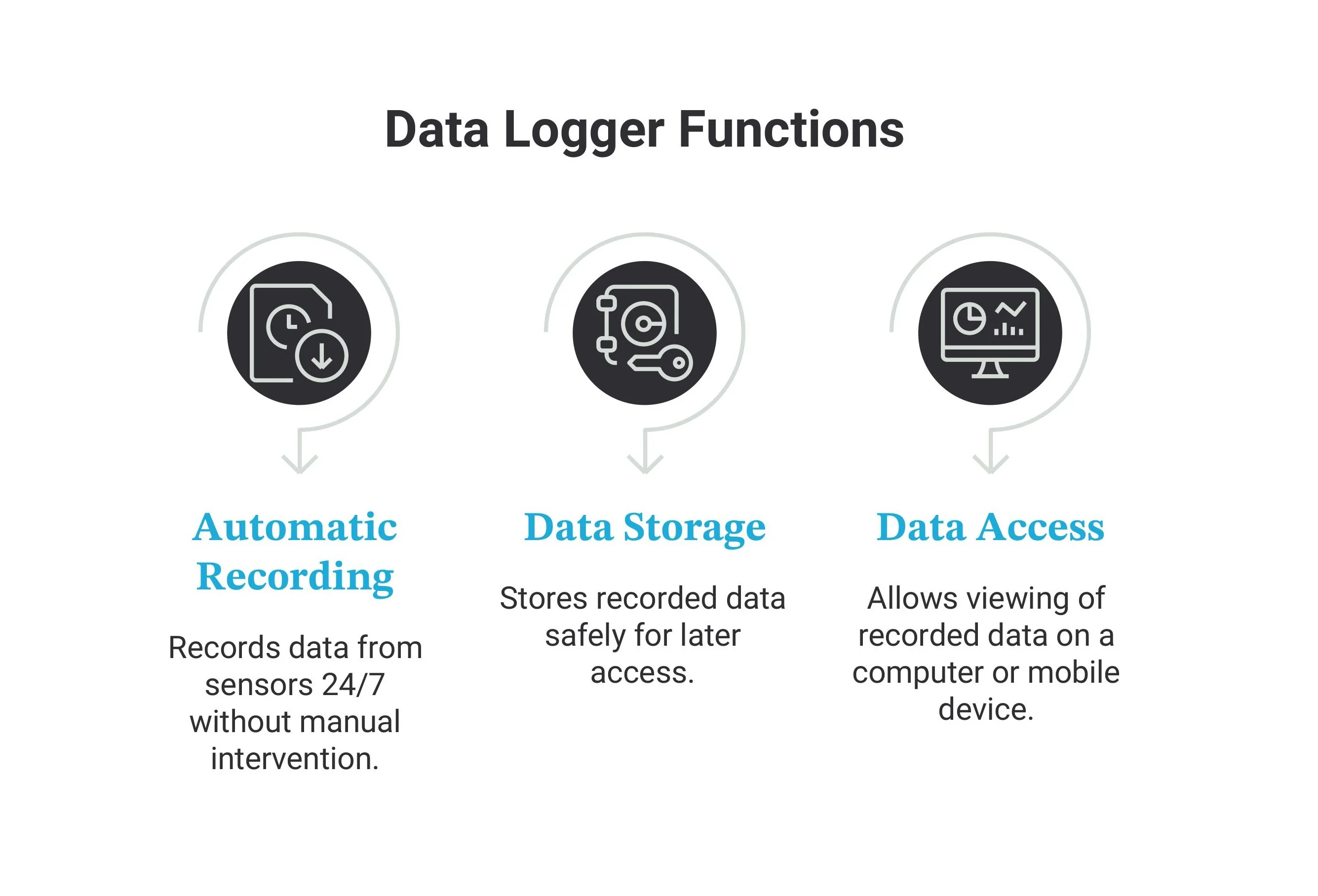 Typical functions of a data logger, measuring and
recording key parameters automatically.
Typical functions of a data logger, measuring and
recording key parameters automatically.
A normal thermometer or meter only tells you the reading at that exact moment. The second you look away, that information is gone. A data logger, on the other hand, keeps a continuous record, taking a reading every few minutes or hours, day and night, without anyone touching it.
It works 24×7, without needing a person to check manually. Once installed, it keeps recording data every few minutes or hours and stores it safely. You can later see this data on a computer or mobile, spot exactly when something went wrong, and even prove your conditions were safe during an audit or a customer complaint.
Why Are There Different Types of Data Loggers?
Every business has different risks.
- A cold storage facility worries about temperature.
- A grain warehouse worries about humidity.
- A factory worries about electricity and machines.
- A hotel worries about water and power.
- A pharma company worries about compliance.
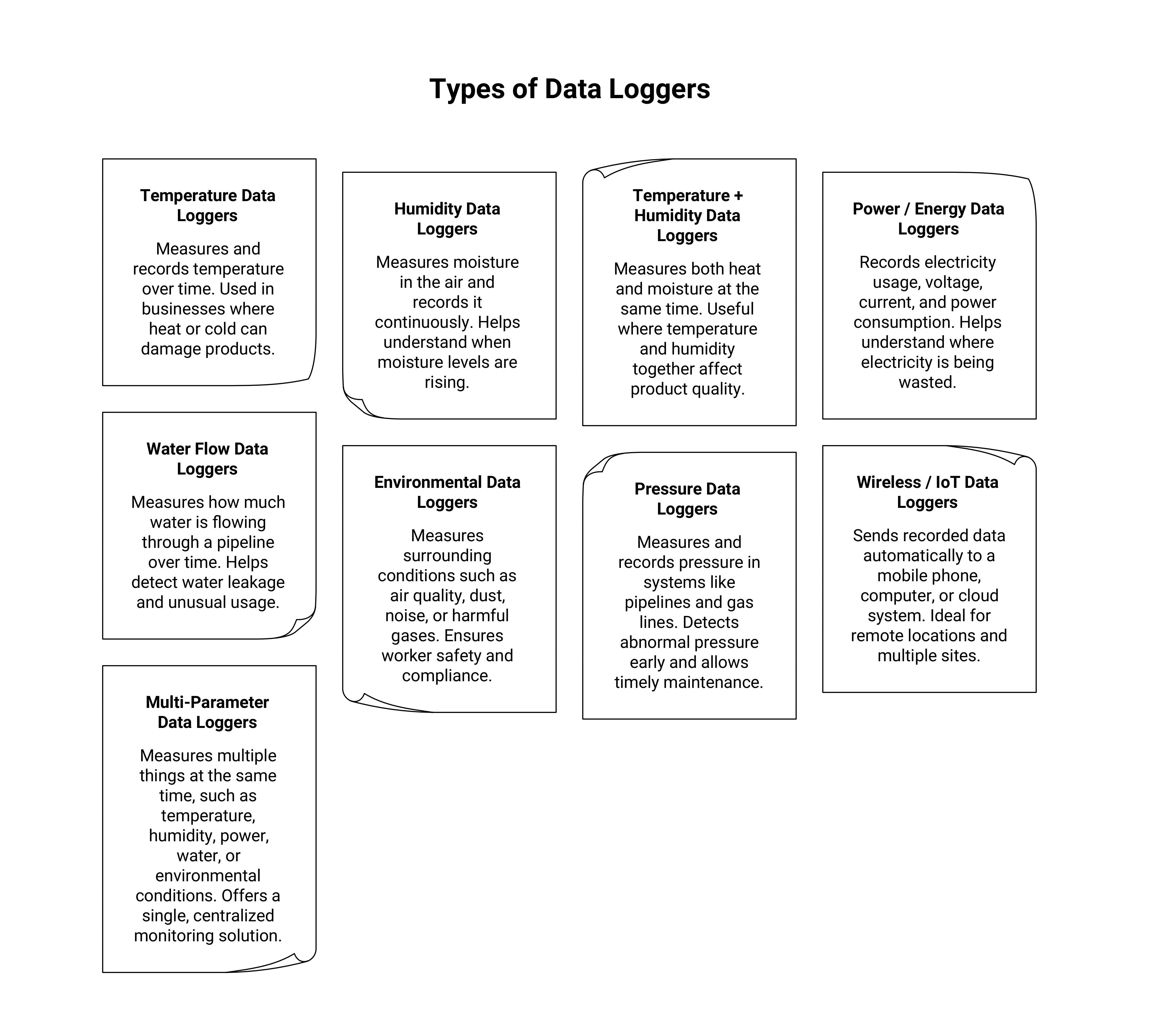 Selecting the right type of data logger depends on the
specific risks and needs of your business.
Selecting the right type of data logger depends on the
specific risks and needs of your business.
So, one type of data logger cannot solve all problems. That’s why data loggers are made in different types, each for a specific purpose.
Let’s understand them one by one.
Most Popular 9 Types of Data Loggers
1. Temperature Data Loggers
A temperature data logger is a device that continuously measures and records temperature over time without manual checking. It is mainly used in businesses where heat or cold can damage products, such as cold storage, medicine shops, vaccine stores, dairy units, and food warehouses.
Instead of checking a thermometer a few times a day, this logger keeps watch 24×7 and records every small change. If the temperature goes above or below safe limits, it helps identify the problem early, before goods get spoiled and money is lost.
What Do They Measure?
- Current temperature (in °C or °F)
- Highest and lowest temperature over a period
- Temperature changes and fluctuations over time
- How long did the temperature stay outside the safe range
Where Are They Used?
- Cold storages
- Vaccine and medicine storage
- Dairy and ice cream units
- Food warehouses
- Restaurants and hotels
- Chemical and paint storage
Why They Matter
According to global food safety studies, nearly 30-40% of time and temperature sensitive food in India gets wasted.
In the pharmaceutical industry, even 2-3°C temperature changes can make vaccines and medicines ineffective. This means one night of high temperature can destroy stock worth lakhs.
If your business involves anything that can spoil, this logger is not optional; it’s necessary. A simple temperature data logger with alerts could have saved everything.
2. Humidity Data Loggers
A humidity data logger measures the moisture present in the air and records it continuously. Many businesses ignore humidity, but it can actually damage goods like grains, textiles, paper, electronics, and packaged food. High humidity can cause fungus, bad smell, insects, and product rejection.
A humidity data logger helps business owners understand when moisture levels are rising and take action early, especially during monsoon season when humidity stays high for many days.
What Do They Measure?
- Relative humidity (moisture level in the air, shown as %)
- Rise and fall of moisture over time
- Peak humidity during the day or season
- How long humidity stays above the safe limit
Where Are They Used?
- Grain warehouses (wheat, rice, pulses)
- Paper storage
- Textile and garment units
- Electronics storage
- Libraries and record rooms
Why They Matter
Studies show that high humidity can cause up to 20-25% loss in stored grains due to fungus, insects, and spoilage.
During the monsoon season in India, humidity levels can stay above 70-80% for weeks, which is dangerous for storage. Many businesses notice the problem only when fungus or smell appears, which means damage has already happened. A humidity data logger would have shown the problem within the first few days.
3. Temperature + Humidity Data Loggers
A temperature and humidity data logger measures both heat and moisture at the same time using a single device. This type of logger is very useful where temperature and humidity together affect product quality, such as cold storage rooms, food processing units, pharma warehouses, and export packaging areas.
Instead of using two separate devices, this combo logger gives a complete picture of storage conditions and helps businesses maintain proper quality standards with less effort and cost.
What Do They Measure?
- Temperature (in °C or °F)
- Relative humidity (%)
- Combined effect of heat and moisture
- Both readings on a single timeline, so you can see how they change side by side
Where Are They Used?
- Cold storage with open doors
- Food processing units
- Pharma warehouses
- Export packaging units
Why They Matter
Temperature alone is not enough. For example:
- Chocolate melts due to heat.
- But packaging gets damaged due to humidity.
Around 60% of cold-chain businesses worldwide now use combined temperature-humidity loggers because single-parameter monitoring is not enough.
4. Voltage & Current Data Loggers
A voltage & current data logger records electricity usage, voltage, current, and power consumption over time. It helps factories, workshops, cold storages, hotels, and commercial buildings understand where electricity is being wasted. Many businesses get high electricity bills but don’t know the exact reason.
This logger shows which machines consume more power, when power usage is highest, and where improvements can be made to reduce monthly bills and avoid electrical problems.
What Do They Measure?
- Electricity consumption
- Voltage
- Current
- Power usage patterns
Where Are They Used?
- Factories
- Workshops
- Cold storages
- Hotels
- Commercial buildings
Why They Matter
Energy studies show that 10-20% of electricity in small industries is wasted due to inefficient usage, idle machines, and voltage issues. Many factories don’t know which machine consumes the most power. Fixing just that one machine saves thousands of rupees every month.
5. Water Flow Data Loggers
A water flow data logger measures how much water is flowing through a pipeline over time. It is commonly used in factories, bottling plants, hotels, large buildings, and agricultural systems. This type of logger helps detect water leakage, unusual usage, or continuous flow during non-working hours.
By tracking actual water consumption, businesses can reduce wastage, control costs, and quickly identify problems in pipelines before they turn into major losses.
What Do They Measure?
- Water flow rate
- Total water consumption
Where Are They Used?
- Industries
- Bottling plants
- Large buildings
- Agriculture
Why They Matter
Studies show that 15-25% of industrial water is lost due to leaks, often unnoticed. Flow data loggers help detect:
- Sudden drops
- Continuous flow at odd hours
- Pipeline leakage
Businesses can take early action before a big loss.
6. Environmental Data Loggers
An environmental data logger measures surrounding conditions such as air quality, dust level, noise, or harmful gases. It is mainly used in factories, chemical units, construction sites, laboratories, and manufacturing plants.
These loggers help ensure worker safety and support compliance with safety rules and audits. Instead of guessing or giving verbal explanations, businesses get recorded proof that environmental conditions are within safe limits.
What Do They Measure?
- Air quality
- Dust
- Noise levels
- Gas concentration
Where Are They Used?
- Manufacturing plants
- Chemical units
- Construction sites
- Laboratories
Why They Matter
Poor air quality and dust exposure cause health issues and legal problems. Many safety audits now require recorded environmental data, not verbal explanation. Environmental data loggers provide proof, not excuses.
7. Pressure Data Loggers
A pressure data logger measures and records pressure in systems like pipelines, gas lines, hydraulic machines, or industrial equipment. Sudden pressure changes can cause leakage, machine damage, or accidents.
This type of logger helps detect abnormal pressure early and allows timely maintenance. It is widely used in water supply systems, oil and gas applications, and heavy industrial machinery where pressure control is critical for safety and smooth operation.
What Do They Measure?
- Pressure in pipelines
- Gas systems
- Hydraulic machines
Where Are They Used?
- Oil & gas
- Water pipelines
- Industrial machinery
Why They Matter
Pressure problems can cause:
- Leakage
- Equipment damage
- Accidents
Pressure data loggers help detect abnormal pressure early, preventing breakdowns.
8. Wireless / IoT Data Loggers
A wireless or IoT data logger sends recorded data automatically to a mobile phone, computer, or cloud system without manual downloading. It is ideal for businesses that have remote locations or multiple sites and cannot check each place daily.
These loggers provide real-time monitoring and instant alerts, helping business owners take quick action even when they are not physically present at the site.
What Makes Them Different?
- Send data automatically to mobile or cloud
- Real-time alerts
- No manual data download
Where Are They Used?
- Remote locations
- Multiple sites
- Businesses with limited manpower
Why They Matter
Businesses using real-time monitoring systems report up to a 25% reduction in losses compared to manual monitoring. Wireless data loggers are perfect when:
- You can’t visit the site daily
- You manage multiple locations
9. Multi-Channel Data Loggers
A multi-channel data logger can measure multiple things at the same time, such as temperature, humidity, power, water, or environmental conditions, depending on the model. It is suitable for large facilities or complex operations where different factors affect business performance.
Instead of installing many separate devices, this logger offers a single, centralized monitoring solution and is useful for long-term planning, audits, and advanced analysis.
What Do They Measure?
- Temperature
- Humidity
- Power
- Water
- Environment (depending on model)
Where Are They Used?
- Large factories and manufacturing plants
- Cold storage and warehouse chains
- Pharma and food processing units
- Multi-department facilities
- Businesses running audits and compliance checks
Why They Matter
Big facilities don't fail because of one problem; they fail because many small problems happen at once, in different places, and nobody connects them.
A multi-channel logger solves this by tracking everything from a single point. Instead of one person checking temperature here, another checking power there, and someone else noting water usage, all the data comes together on one screen. This makes it easy to spot patterns, like how a power drop affects temperature, or how humidity rises when a door stays open.
For large operations, this isn't just convenient, it's smarter decision-making. One combined record replaces dozens of scattered readings, saves manpower, and gives you the complete picture needed for audits, long-term planning, and preventing losses before they add up.
The Side-by-Side Data Logger Comparison
| Data Logger Type | What It Measures | Where It's Used | Why It Matters (Key Stat/Benefit) |
|---|---|---|---|
| Temperature Data Logger | Current temperature (°C/°F), highest & lowest readings, fluctuations, time spent outside safe range | Cold storages, vaccine & medicine storage, dairy & ice cream units, food warehouses, restaurants & hotels, chemical & paint storage | 30–40% of temperature-sensitive food in India is wasted; even a 2–3°C change can ruin vaccines and stock worth lakhs |
| Humidity Data Logger | Relative humidity (%), rise & fall of moisture, peak humidity, time above safe limit | Grain warehouses, paper storage, textile & garment units, electronics storage, libraries & record rooms | High humidity causes up to 20–25% loss in stored grains; monsoon humidity can stay 70–80% for weeks |
| Temperature + Humidity Data Logger | Temperature (°C/°F), relative humidity (%), combined heat-moisture effect on a single timeline | Cold storage with open doors, food processing units, pharma warehouses, export packaging units | ~60% of cold-chain businesses use combined loggers, as single-parameter monitoring isn't enough |
| Voltage & Current Data Logger | Electricity consumption, voltage, current, power usage patterns | Factories, workshops, cold storage, hotels, commercial buildings | 10–20% of electricity in small industries is wasted; fixing one machine can save thousands monthly |
| Water Flow Data Logger | Water flow rate, total water consumption | Industries, bottling plants, large buildings, agriculture | 15–25% of industrial water is lost to unnoticed leaks; detects odd-hour flow and pipeline leakage |
| Environmental Data Logger | Air quality, dust, noise levels, gas concentration | Manufacturing plants, chemical units, construction sites, laboratories | Provides recorded proof for safety audits and protects workers from health & legal risks |
| Pressure Data Logger | Pressure in pipelines, gas systems, hydraulic machines | Oil & gas, water pipelines, industrial machinery | Detects abnormal pressure early to prevent leakage, equipment damage, and accidents |
| Wireless / IoT Data Logger | Auto-sends data to mobile/cloud, real-time alerts, no manual download | Remote locations, multiple sites, businesses with limited manpower | Real-time monitoring reports up to 25% reduction in losses vs manual checking |
| Multi-Channel Data Logger | Temperature, humidity, power, water, environment (depending on model) | Large factories, cold storage & warehouse chains, pharma & food units, multi-department facilities, audit-heavy businesses | Tracks everything from one point; replaces multiple devices and reveals hidden patterns |
Conclusion: Don’t Wait Until It’s Too Late
Every business owner already tracks the things they can see like sales, stock, staff, orders. But the biggest losses usually come from the things nobody is watching. They build up in the background until one day they show up as a ruined batch, a shocking bill, or a failed audit.
That's the gap a data logger fills. It doesn't run your business for you. It simply makes the invisible visible and gives you the time to act before small problems become expensive ones.
So the takeaway is, don't ask whether you need a data logger. Ask what silent risk is sitting in your business right now, unwatched, and what it would cost you the day it finally speaks up. The businesses that thrive aren't the ones that react fastest to disaster. They're the ones who saw it coming.