Key Takeaways:
- A logger that only records numbers isn’t enough. In pharma, the real value is data you can defend in an audit. Accurate readings mean little if you can’t prove nobody changed or deleted them.
- The software matters more than hardware. The device collects the data, but the software (audit trails, e-signatures, user roles) is what makes it compliant. Many buyers focus on the device and miss this.
- Where you place the sensor is as important as how good it is. A perfect sensor in the wrong spot gives you perfect data about the wrong place. Do temperature mapping first, then put loggers at the hottest and coldest points.
- An alarm is only useful if someone acts on it. Real-time alerts need escalation: if the first person doesn’t respond, the alert should go to the next person automatically. Auditors also want proof of who responded and when.
- The cheapest option often costs the most. A low-cost logger without proper compliance features can lead to a failed inspection, lost batches, and slow service. Local support and validation documents (IQ/OQ/PQ) save time and money later.
When pharmaceutical products must stay within specific environmental limits, even a small temperature change can create a serious quality concern. A missed reading, incomplete record, or delayed alarm can make it harder to protect products and demonstrate compliance during an audit.
That is why choosing the right data logger for pharma is more than a technical decision. It is an investment in product quality, data integrity, and peace of mind.
But which features should you look for? And how do 21 CFR Part 11 and HACCP affect your buying decision?
In this guide, I’ll explain what 21 CFR Part 11 and HACCP really require, which features matter most, and what to ask before you buy.
Why the Right Data Logger Matters in Pharma?

Medicines are sensitive. Vaccines, insulin, biologics, and many APIs can lose strength if they get too warm, too cold, or too humid. A small swing can ruin a full batch.
A pharmaceutical data logger records temperature, humidity, and other conditions automatically, around the clock. But in pharma, recording data is only half the job. The data must also be trustworthy. Regulators want proof that nobody changed, deleted, or faked it.
This is called data integrity. Most regulators follow the ALCOA+ principle. Data must be Attributable, Legible, Contemporaneous, Original, and Accurate, plus Complete, Consistent, Enduring, and Available.
A cheap logger only records numbers. But a compliant logger records numbers you can defend in an audit. That difference is what this guide is about.
What Is 21 CFR Part 11? A Simple Explanation
21 CFR Part 11 is a US FDA regulation. It explains when electronic records and electronic signatures can be trusted as much as paper records and handwritten signatures.
If your plant exports to the US, or your clients follow FDA rules, it applies to you. Many Indian companies also treat it as the gold standard. India’s revised CDSCO Schedule M also strongly emphasizes data integrity and computerised systems.
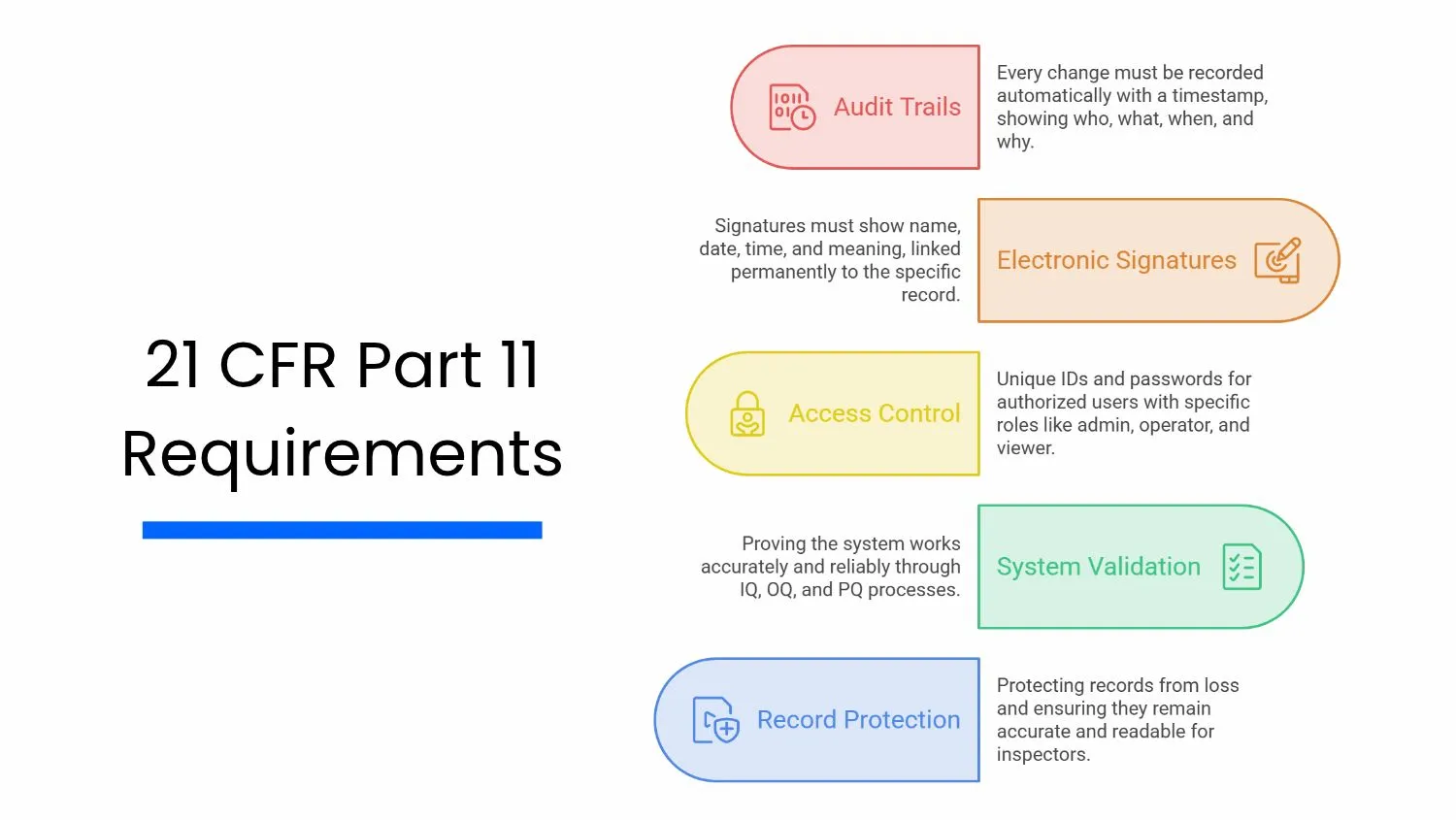
Here is what Part 11 expects from your monitoring system:
1. Secure, Computer-Generated Audit Trails
Every change must be recorded automatically with a timestamp. The system should show who did it, what changed, when, and why. Old values must stay visible, and no user should be able to switch off or edit the audit trail.
2. Electronic Signatures
When someone approves a report or acknowledges an alarm, the signature must show their name, the date and time, and the meaning, such as “reviewed” or “approved.” The signature must be linked to that record so it cannot be copied elsewhere.
3. Access Control and User Roles
Only authorised people should log in. Each user needs a unique ID and password. Roles like admin, operator, and viewer stop people from doing things outside their job.
4. System Validation
The system must be validated to prove it works accurately and reliably. This is usually done through IQ, OQ, and PQ (Installation, Operational, and Performance Qualification).
5. Record Protection and Retention
Records must be protected from loss for the full retention period. You must also be able to produce accurate, readable copies for inspectors.
What HACCP Requirements Mean for Data Logging
HACCP stands for Hazard Analysis and Critical Control Points. It began in food safety, but it is now common in nutraceuticals, food-grade excipients, and plants with shared food and pharma lines. In India, FSSAI also expects food businesses to run safety systems based on HACCP principles.
HACCP has seven principles. Three of them depend directly on good monitoring:
- Set critical limits: For example, a cold store must stay between 2°C and 8°C.
- Monitor critical control points (CCPs): A data logger checks these limits every minute, not just twice a shift.
- Keep records and verify: Auditors want continuous logs, corrective action notes, and proof that sensors were calibrated.
In simple words, HACCP asks three questions. Did you watch the right point? Did you act when something went wrong? Can you prove it? A good HACCP data logger helps you answer “yes” to all three.
Data Logger Buying Checklist: 10 Features That Matter
Use this checklist when you compare products. Each point protects either your product or your audit.
- Accuracy and range: For cold chain and stability rooms, look for about ±0.1°C to ±0.5°C temperature accuracy and about ±1.5-2% humidity accuracy. Make sure the range covers everything from freezers to warehouses.
- Traceable calibration: Ask for a calibration certificate traceable to national standards, ideally from an NABL-accredited lab. Plan to recalibrate at least once a year.
- Tamper-proof audit trail: The software should log every login, setting change, and acknowledgement automatically.
- Electronic signatures and user roles: Look for role-based access, unique logins, password rules, and auto-logout.
- Real-time alarms: SMS, email, and WhatsApp alerts help your team react within minutes, even at night. An acknowledgement history shows who responded and when.
- No data loss during outages: Local buffering, SD card storage, and battery backup keep recording when power or the network fails.
- Secure cloud storage: Encrypted data transfer, regular backups, and easy export to PDF, CSV, or Excel.
- Audit-ready reports: Minimum, maximum, and average values, trend graphs, and excursion reports you can print in one click.
- Validation support: A good supplier provides IQ/OQ/PQ templates and technical documents to save you weeks of work.
- Scalability: A multi-channel logger monitors many points from one device. This cuts wiring, cost, and clutter as your plant grows.
Common Mistakes Pharma Buyers Make
Mistakes are easy to make when you are busy. Here are the ones we see most often:
- Buying on price alone: A low-cost logger without an audit trail can cost far more after one failed inspection.
- Ignoring the software: The hardware records the data, but the software is what makes it compliant.
- Skipping temperature mapping: A sensor in the wrong spot gives you perfect data about the wrong place. Map your rooms first, then place loggers at the hot and cold spots.
- Forgetting alarm escalation: If the first person does not respond, the alarm should reach the next person automatically.
- Choosing a supplier with no local support: When a sensor fails a week before an audit, you need help in days, not weeks.
Questions to Ask Your Data Logger Supplier
Before you sign a purchase order, ask these simple questions. A right supplier will be happy to answer them.
- Can you show me the audit trail and e-signature workflow in a live demo?
- Is your calibration certificate NABL-traceable?
- What happens to my data if the internet goes down for 24 hours?
- Do you provide IQ/OQ/PQ documents?
- How quickly can your team reach my site for service?
- Can I add more channels later without replacing the system?
Their answers will tell you more than any brochure ever could.
How AIOTHUB Supports Pharma Compliance
At AIOTHUB, we design and build our data loggers in Vadodara, Gujarat, for Indian plants that cannot afford downtime.
Our temperature data logger delivers ±0.1°C precision from −40°C to +125°C, with 21 CFR Part 11-ready reports and HACCP-friendly records. For cleanrooms and stability chambers, our humidity data logger tracks relative humidity with ±1.5% accuracy.
Need to watch many points at once? Our multi-channel data logger supports up to 6 channels with built-in buffering and SD storage. Every system includes a secure cloud dashboard, role-based access, time-stamped records, and instant SMS, email, and WhatsApp alerts.
Because our products are 100% made in India, you get faster delivery and local support when you need it most. Explore our pharma data logger solutions to learn more.
Final Thoughts: Buy Peace of Mind, Not Just a Device
The best data logger for pharma does more than record environmental readings. With the right data logger, your phone buzzes within minutes when it identifies deviations. Your team moves the stock to safety. The audit trail records every step. When the inspector arrives, you hand over a clean report with a smile.
That is what a good data logger gives you: patient safety, product protection, and confidence in front of any auditor.
Ready to find the right fit for your plant? Talk to our experts today. Tell us what you need to monitor, and we will help you choose a solution that fits both your process and your budget.
You May Also Like:
- USB vs Cloud-Based Data Logger: Costs, Features & Benefits
- Single-Channel vs Multi-Channel Data Logger: Which One Should You Buy?
- Manual Logging vs Data Logger: 3-Year Cost Comparison
Frequently Asked Questions
Is a 21 CFR Part 11 data logger enough to ensure compliance?
No. The data logger is only one part of the compliance process. Applicable regulations, system configuration, validation, procedures, access controls, and staff practices also matter.
How often should a pharma data logger be calibrated?
Most companies calibrate once a year. Critical areas may need more frequent checks, based on your risk assessment and SOPs.
Can a data logger replace manual temperature logs?
It can automate much of routine monitoring and reporting, where permitted by your approved procedures. Your quality team should decide whether existing manual checks must continue as independent or backup controls.
What is the difference between HACCP and Part 11 requirements?
HACCP focuses on monitoring critical control points and keeping records. Part 11 focuses on making those electronic records secure and trustworthy. A good pharma logger supports both.
Can one system monitor cold rooms, warehouses, and cleanrooms?
Yes. A multi-channel, cloud-connected system can track temperature, humidity, and other parameters across many areas from a single dashboard.