Key Takeaways:
- Cloud connection doesn’t mean your data is safe. If the network goes down, a logger without enough local memory lose readings. Check that it stores data offline and syncs automatically once the connection is back.
- A “compliant” label from the manufacturer isn’t enough. In pharma and food plants, the whole setup, including the software and your own procedures, must be checked and validated for your facility.
- The cheapest logger can be the most expensive. Sensors, wiring, software subscriptions, calibration, and training add up. A device that needs frequent manual checks or doesn’t connect with your existing systems also costs you time and money over the years.
- Faster sampling isn’t always better. Recording too often fills up storage quickly, and recording too slowly misses short spikes. Choose the right rate based on how fast the parameter you’re measuring actually changes.
- Start small, then expand, and involve other teams. Talking to your maintenance, quality, and production teams before you buy helps you avoid choosing a logger that only fits one team’s needs.
Selecting the right 'data logger' is crucial for any plant manager aiming to maintain product quality, minimize downtime, and ensure the smooth operation of industrial processes. A reliable data logger records critical parameters—such as temperature, humidity, pressure, voltage, and current—help teams to gain insight into plant activities and take appropriate action accordingly.
However, with a wide range of models, sensors, and connectivity options available in the market today, a plant manager might find it challenging to choose the most suitable industrial data logger. Therefore, always make your selection by carefully considering your specific requirements, operational conditions, and budget.
Whether you manage a manufacturing unit, a pharmaceutical facility, a food processing plant, or a warehouse, choosing a data logger tailored to your specific operations can improve monitoring and reduce avoidable risks.
Why Is Choosing the Right Data Logger Important?
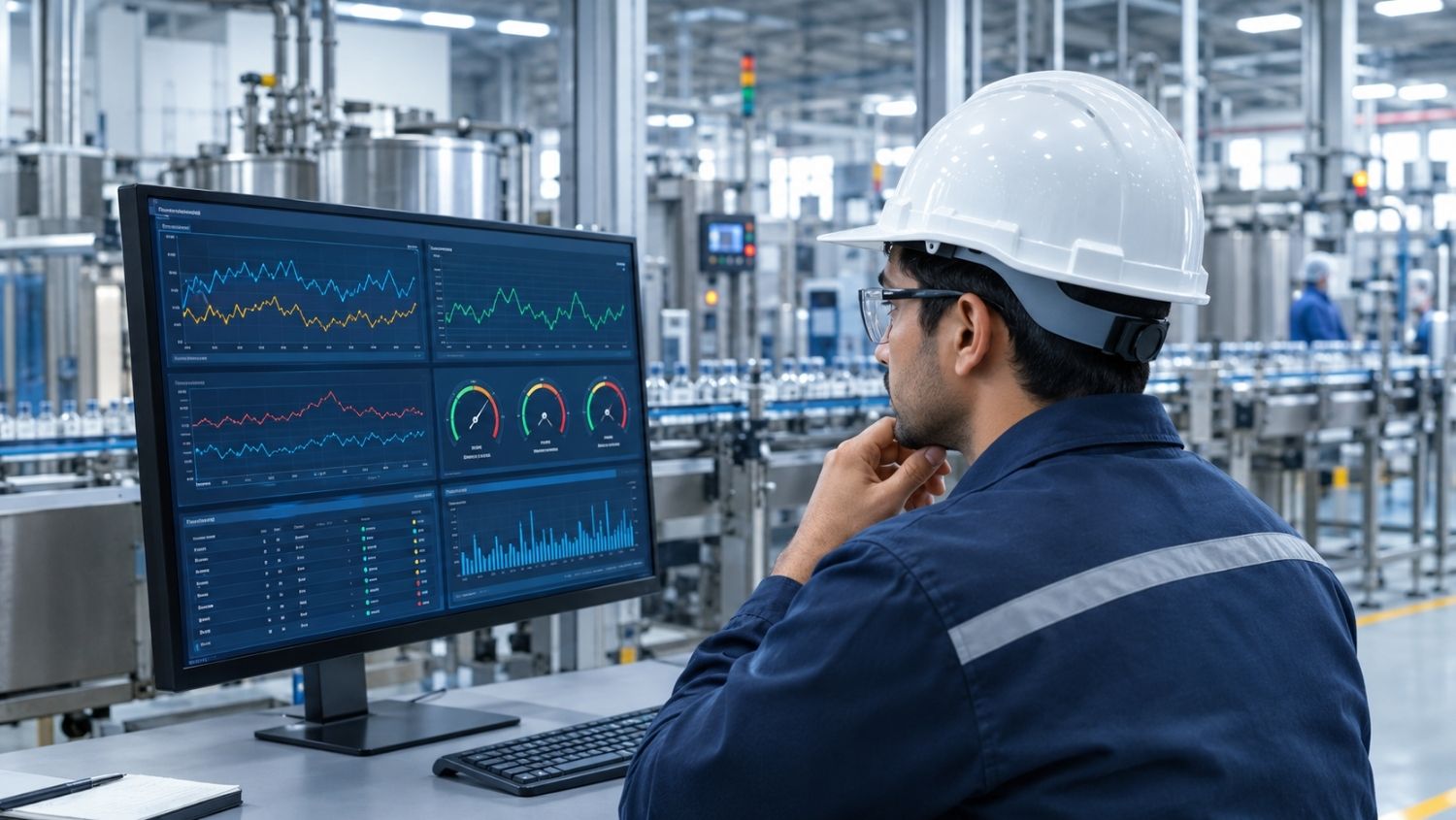
The performance of industrial plant relies on stable operating conditions. Sudden temperature spikes, pressure fluctuations, or unexpected power variations negatively impact product quality, equipment performance, and production schedules.
So, relying on manual readings cause you to miss short-term fluctuations, especially when equipment operates across multiple shifts. For such manufacturing plants, an industrial data logger automatically records measurements, enabling your teams to analyze trends, set alerts, and investigate issues based on the recorded data.
However, not every data logger is suitable for every application. A logger designed for monitoring warehouse temperatures, for instance, may not be capable of meeting the requirements of a process involving rapidly changing pressure.
So, use this six-point checklist before buying.
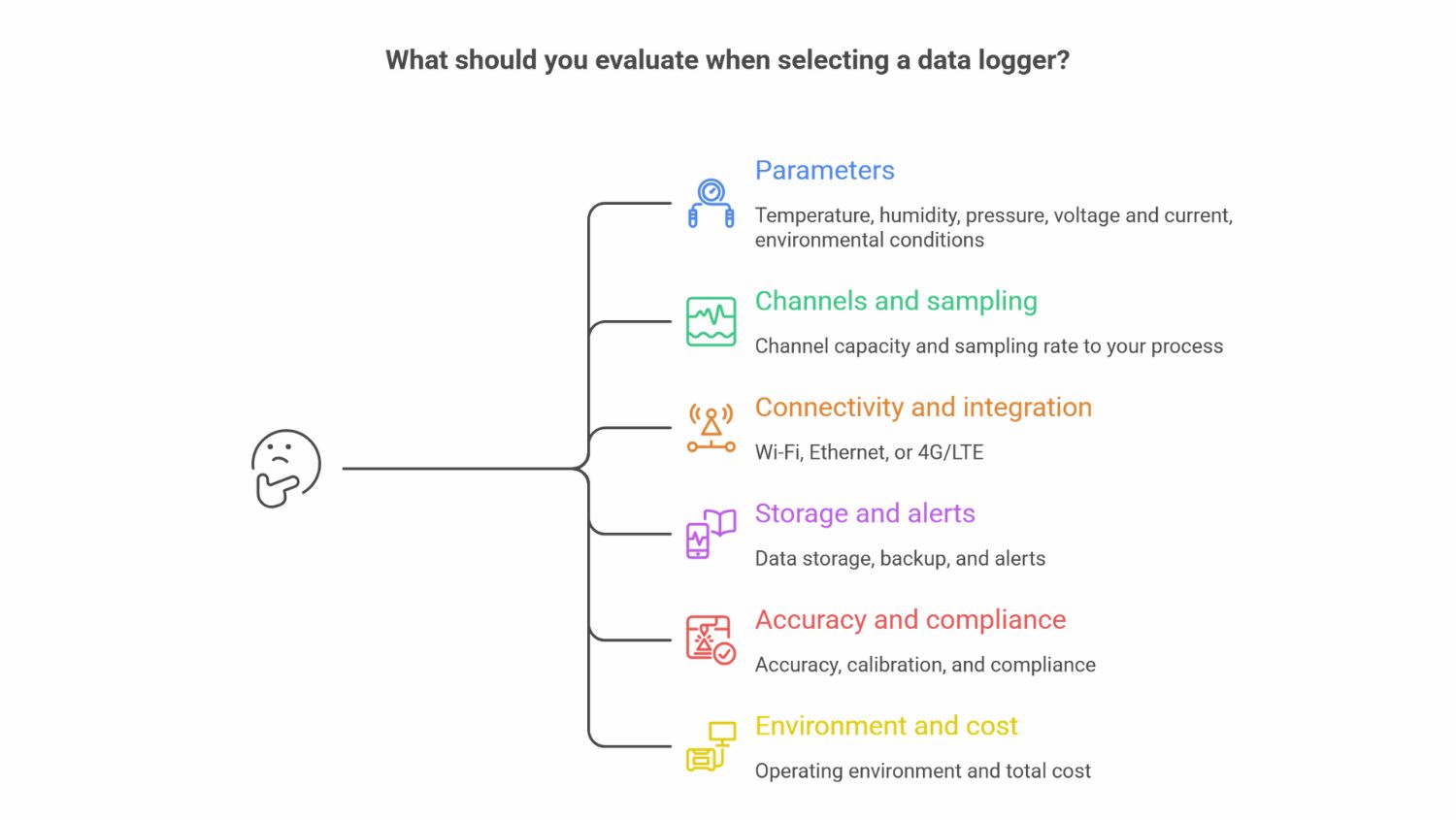
1. Identify the Parameters You Need to Measure
Start by defining exactly what your plant needs to monitor. Common industrial parameters include:
- Temperature: Motors, ovens, cold rooms, storage areas, and process equipment.
- Humidity: Warehouses, cleanrooms, pharmaceutical storage, and HVAC systems.
- Pressure: Pumps, pipelines, boilers, and hydraulic systems.
- Voltage and current: Electrical panels, machines, and energy consumption.
- Environmental conditions: Carbon dioxide, air quality, and other application-specific measurements.
Next, check sensor compatibility. Confirm the measurement range and accuracy required by your process. For example, a temperature logger used in a cold room must handle the expected operating temperatures without losing measurement accuracy.
Buying tip: List every parameter, sensor type, measurement range, and acceptable error before comparing data logger models.
2. Match Channel Capacity and Sampling Rate to Your Process
Channel capacity determines how many sensor inputs a logger can monitor simultaneously, while the sampling rate determines how frequently it records readings (measurements).
A single-channel data logger is suitable for monitoring a single critical temperature point. On the other hand, when you need to monitor multiple machines, storage areas, or process conditions from a single location, a multi-channel data logger proves to be more practical.
Your sampling rate should match how quickly the monitored parameter can change.
For example, monitoring warehouse temperature requires readings every few minutes, whereas a rapidly changing pressure process requires very fast sampling to capture short-duration events.
Before purchasing, ask yourself these questions:
- How many sensors are required today?
- Will the plant need additional monitoring points later?
- How quickly can the parameter change?
- How much storage will the selected sampling interval require?
Buying tip: Do not pay for unnecessary channels, but leave enough capacity for planned expansion.
3. Check Connectivity and System Integration
A data logger becomes more useful when the recorded information reaches the right people and systems.
Depending on your plant layout, suitable connectivity options include Wi-Fi, Ethernet, or 4G/LTE. Remote facilities benefit from cellular connectivity, while networked production areas typically prefer Ethernet.
If you already use PLCs, SCADA, or plant-wide monitoring platforms, check whether the logger supports the necessary communication methods.
Additionally, determine how operators will access the readings. Features such as web dashboards, historical charts, downloadable reports, and remote alerts reduce the need for frequent manual checks.
Buying tip: Verify compatibility with your existing systems before ordering. Ask the supplier to demonstrate data transfer and alarm functions if integration is critical.
4. Evaluate Data Storage, Backup, and Alerts
Having multiple connectivity options alone is not sufficient. Networks can sometimes fail, and in such situations, the logger must continue to capture critical measurements.
Therefore, choose devices that have sufficient internal memory or local storage (such as an SD card). Verify what happens when the network disconnects—specifically, how much data can be stored, and whether the stored data is automatically synchronized once connectivity is restored.
Alerts are equally important. An effective monitoring system must allow for the setting of operational limits, ensuring that relevant personnel are notified whenever measurements fall outside these defined limits.
For example, if a cold-storage temperature crosses its approved threshold, a timely alert helps the team investigate before the issue develops into a larger quality problem.
Check whether the system provides:
- Configurable high and low limits.
- SMS, email, or other supported notifications.
- Time-stamped historical records.
- Clear alarm history and acknowledgement tracking.
- Data export for maintenance reports and audits.
Buying tip: Ask for a demonstration of offline data buffering and recovery, as cloud connectivity does not automatically guarantee uninterrupted recording.
5. Verify Accuracy, Calibration, and Compliance
The accuracy of measurements impacts the decisions made by your team. For instance, unreliable readings can trigger unnecessary alarms or hide a genuine process deviation.
Therefore, before making a purchase, review the logger's accuracy specifications, sensor performance, calibration procedures, and recalibration schedule. If your application requires traceability, request the relevant calibration certificate and verify which standards or reference laboratories support it.
Industries involved in pharmaceutical, food, and life-science operations require additional scrutiny. Consequently, they necessitate controlled access, audit trails, secure records, and validated processes.
For electronic records, evaluate whether the complete monitoring system meets the requirements applicable to your facility. A manufacturer's general claim of compliance does not replace application-specific validation or the evaluation of software and operating procedures.
Buying tip: Confirm the necessary calibration documentation and compliance features during the final stage of the purchase, prior to installation.
6. Assess the Operating Environment and Total Cost
A data logger installed in a clean control room faces different conditions compared to one placed near machinery, in a washdown area, or inside a remote utility enclosure.
Therefore, where applicable, evaluate factors such as operating temperature, enclosure protection, mounting options, power supply, backup requirements, and resistance to electrical interference.
Look beyond the initial purchase price. When calculating the total cost of ownership, include expenses for sensors, installation, wiring, software subscriptions, calibration, maintenance, replacement parts, and training. A low-cost device can end up being expensive if it requires frequent manual checks or cannot be integrated with your existing systems.
Compare your shortlisted suppliers based on technical suitability, after-sales service, warranty, availability of calibration support, and ease of future expansion.
Buying tip: Instead of comparing only hardware costs, evaluate the complete system, including the logger, sensors, software, connectivity, and support.
Real-World Lessons from Industrial Monitoring Case Studies
Case study: YaoPharma's pharmaceutical warehouse monitoring

A case study published by Vaisala describes how the Chinese pharmaceutical manufacturer, YaoPharma, moved beyond the practice of manually downloading data from traditional loggers.
To meet its quality and regulatory requirements, the company needed temperature and humidity monitoring, real-time alerts, and more efficient reporting. After evaluating various suppliers, they selected a continuous monitoring system that was compatible with their existing network.
YaoPharma first tested this system in one of its warehouses and subsequently extended monitoring to other storage areas. As part of this implementation, 22 data loggers equipped with temperature and humidity sensors were installed. This enabled staff to remotely view critical readings, receive alerts, and access audit trails and reports.
Lesson for plant managers: When choosing a logger, check how easily it integrates with your network; also, consider future expansion and whether it can translate measurements into effective alerts. These capabilities are just as important as the sensors themselves.
Source: Vaisala's YaoPharma case study.
Common Mistakes to Avoid When Buying a Data Logger
Even a feature-rich data logger can be the wrong choice if it does not align with your specific processes. Therefore, avoid these common mistakes:
- Never select a data logger based solely on price or advertised accuracy.
- Don’t overlook sensor compatibility and measurement ranges.
- Do not choose a device with too few channels, failing to account for planned future expansion.
- Never ignore the risk of network failure; prioritize the availability of local storage.
- Always examine supplier support, calibration, and maintenance costs.
Before finalizing a data logger supplier, it is necessary to conduct a brief review with your maintenance, quality, production, and IT/OT teams.
Final Checklist: Choose a Data Logger with Confidence
In industrial operations, overlooking minor changes can lead to serious consequences. The true value of a data logger lies not merely in recording what occurred, but in helping plant managers understand “why” it happened. Data loggers enable timely intervention before issues can negatively impact production, quality, or equipment reliability.
The data logger is not just another monitoring device; consider it an investment to provide greater operational visibility. A well-chosen device transforms measurements into meaningful insights, empower your team to shift from reactive problem-solving to proactive prevention.
Choosing the right data logger starts with understanding your process, measurement requirements, and monitoring goals. By checking accuracy, sampling rate, channels, connectivity, storage, and operating conditions, plant managers make a more confident buying decision.
Explore AIOTHUB's industrial data logger solutions to compare monitoring options for manufacturing, utilities, pharmaceutical facilities, and other industrial applications.
You May Also Like:
- USB vs Cloud-Based Data Logger: Costs, Features & Benefits
- Wired vs Wireless Data Loggers: Which Is Better?
- Manual Logging vs Data Logger: 3-Year Cost Comparison
Frequently Asked Questions
What is an industrial data logger, and why does my plant need one?
An industrial data logger is a device that automatically records readings such as temperature, humidity, pressure, voltage, and current over time. It replaces manual readings that can miss short spikes or night-shift changes. With a data logger, your team gets time-stamped records, trend charts, and alerts, so you can spot process deviations early, protect product quality, and plan maintenance with real data.
Which data logger is best for a manufacturing plant?
The best data logger for your plant depends on the parameters you're measuring, the number of sensors, the required sampling rate, operating conditions, and system integration needs. A single-channel logger suits a single monitoring point, while a multi-channel model is better for monitoring multiple sensors in the same or other remote areas.
What happens to my data if the network or Wi-Fi goes down?
A modern wireless data logger never stops recording during a network outage. For example, AIOTHUB loggers store readings in internal memory or on an SD card while offline, then automatically sync the data to the cloud or server once the connection returns. This offline data buffering prevents gaps in your records, which is especially important for quality audits and regulatory reports.
Is a wireless data logger better than a wired logger?
Not always. Wireless models can simplify installation where cabling is difficult. Wired Ethernet or industrial connections are more suitable for fixed installations with existing network infrastructure. Compare reliability, coverage, security, power needs, and integration before deciding.
How often should a data logger record readings?
You can set the interval time based on how quickly the monitored variable changes and the risks associated with missing an event. Slow-changing warehouse temperatures may need less frequent readings than rapidly changing pressure or electrical measurements. Confirm the sampling requirement with your process and quality teams.
What should I check before purchasing a data logger in India?
Check sensor compatibility, measurement accuracy, calibration support, connectivity, local storage, enclosure protection, warranty, and after-sales service. For regulated applications, also verify the relevant documentation and compliance requirements.